If you run a ship management company, a marine spare parts business, a manning agency or a maritime training institute, sooner or later someone asks the same question: how much should a good website actually cost? The honest answer is “it depends” — but that is not very useful when you are trying to set a budget.
So in this guide we break down realistic 2026 price ranges for maritime and shipping websites in India, what drives the cost up or down, the yearly running costs most people forget, and how to plan a budget that gets you enquiries instead of just a pretty homepage.
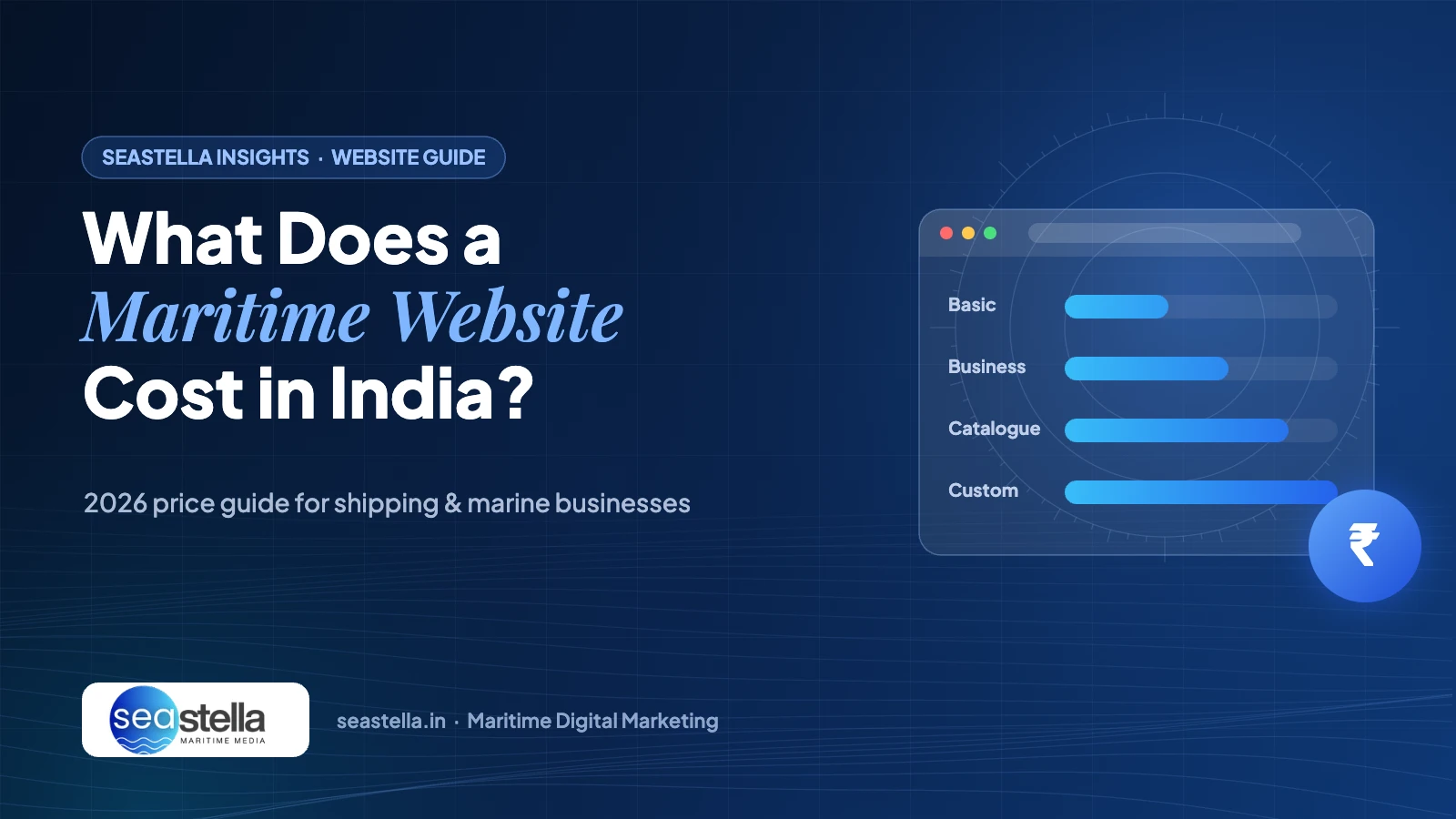
Quick answer: maritime website cost in India (2026)
| Type of website | Typical cost (one-time) | Best suited for |
|---|---|---|
| Company profile website (5–8 pages) | ₹25,000 – ₹60,000 | Marine surveyors, consultants, small service providers |
| Business website with SEO & content (10–20 pages) | ₹60,000 – ₹1,50,000 | Ship managers, manning agencies, marine engineering firms |
| Product catalogue / spare parts website | ₹1,50,000 – ₹4,00,000 | Marine spares suppliers, ship chandlers, equipment dealers |
| Custom portal or web application | ₹4,00,000 and above | Crew portals, booking systems, training institutes with LMS |
These are indicative market ranges for professionally built websites in India. Your actual quote depends on scope, content, integrations and timelines.
Why maritime websites are different from “normal” business websites
A shipping or marine business does not sell to casual visitors. Your website is checked by technical superintendents, procurement teams, charterers, class surveyors and seafarers — often from another country, sometimes on a slow ship connection. That changes what the website needs:
- Trust signals up front – ISO certificates, class approvals, DG Shipping registrations and memberships need to be visible, not buried.
- Technical depth – buyers want specifications, part numbers, vessel types and capabilities, not generic marketing lines.
- Global audience – clear contact options across time zones, WhatsApp, and sometimes multiple languages.
- Speed on low bandwidth – a site that loads well on a VSAT connection on board makes a real difference.
- Enquiry forms built for the industry – fields like vessel name, IMO number, port and ETA save everyone time.
A generic template rarely covers these points, which is why maritime websites sit slightly higher than a basic small-business site.
7 factors that decide your website cost
1. Number of pages and amount of content
A 6-page profile site and a 40-page site with separate pages for every service, port and vessel type are very different jobs. More pages also means more content to write and more SEO work.
2. Custom design vs ready-made theme
A well-chosen theme customised to your brand keeps costs down. A fully custom design — unique layouts, illustrations, animations — takes more design and development time.
3. Product catalogue and RFQ system
For spare parts suppliers and chandlers, the catalogue is the website. Hundreds of products, brand-wise filters, stock highlights and a “request a quote” basket add significant work, especially if data needs to be cleaned and uploaded.
4. Integrations
CRM, WhatsApp chat, email marketing tools, ERP stock sync or vessel tracking widgets all add development time and sometimes third-party subscription fees.
5. Content writing and photography
Many companies underestimate this. Professionally written service pages and real photos of your team, workshop or vessels make a big difference to trust — and they cost money if you do not already have them.
6. SEO setup
Basic on-page SEO (titles, meta descriptions, headings, speed, sitemap) should be included in any good build. Keyword research, service-location pages and blog content are usually a separate, ongoing investment.
7. Timeline and revisions
Rush deadlines (for an upcoming exhibition, for example) and multiple rounds of design changes increase the cost. A clear brief at the start saves money.
Yearly running costs you should budget for
| Item | Approximate cost | Notes |
|---|---|---|
| Domain name (.com / .in) | ₹800 – ₹1,500 per year | Renew on time — expired domains are hard to recover |
| Hosting | ₹3,000 – ₹15,000 per year | Depends on traffic, storage and performance needs |
| Business email | Per user, per month | Google Workspace or Microsoft 365 recommended |
| Maintenance, updates & backups | ₹2,000 – ₹10,000 per month | Security updates, backups, small content changes |
| SEO and content (optional) | Varies by scope | Monthly blogs, technical SEO and reporting |
Premium plugins or theme licences, paid stock photos and SSL certificates (often free with hosting) can also appear as small yearly costs.
Hidden costs to watch out for
- Content writing that was “not included” in the quote
- Stock images and icons purchased later
- Paid plugin licences that need yearly renewal
- Extra charges for each round of revisions
- Migration costs if you move hosting or agencies later
- No handover of admin access, domain or hosting accounts
Always ask for a written scope that lists pages, features, number of revisions, and what happens after launch.
How to plan a smart website budget
- Start with the core – Home, About, Services, Certifications, Contact and a strong enquiry form.
- Phase the rest – add the product catalogue, case studies or multilingual pages in phase two.
- Keep 15–20% for content – good copy and real photos often matter more than fancy animations.
- Plan for the first year – include hosting, maintenance and some SEO so the site actually brings enquiries.
Not sure which features your business really needs? Read our checklist of 10 must-have features of a shipping company website.
How Seastella approaches maritime websites
Seastella is a digital marketing agency focused only on the maritime industry. In the last year our team has delivered 50+ websites for shipping and marine businesses, working with clients across India, Singapore, the UAE, South Korea, Nigeria and Switzerland.
Every project starts with a free digital audit of your current presence, so the quote is based on what you actually need. You can explore our services and packages, or talk to our team for a tailored estimate.
Frequently asked questions
How long does it take to build a maritime website?
A company profile website usually takes 2–4 weeks once content is ready. A product catalogue or spare parts website typically takes 6–10 weeks, depending on the number of products and data quality.
Can I update the website myself?
Yes. Most of our maritime websites are built on WordPress, so your team can update news, products and job openings without coding. We also provide training at handover.
Do I need an e-commerce website?
Most B2B maritime companies do not need online payments. A strong catalogue with a request-for-quote system usually works better, because pricing depends on quantity, port and delivery terms.
Is a cheaper website a bad idea?
Not always — but a very cheap site often skips speed, SEO basics, security and proper enquiry forms. For a maritime business, one good enquiry from the website can pay for the whole project, so it is worth getting the foundations right.
Planning a new website or a redesign? Get a free digital audit from Seastella and a clear, no-surprise quote for your maritime business.